

PCM vs PCB: Which Stream Is Better After Class 10?
Quick Answer
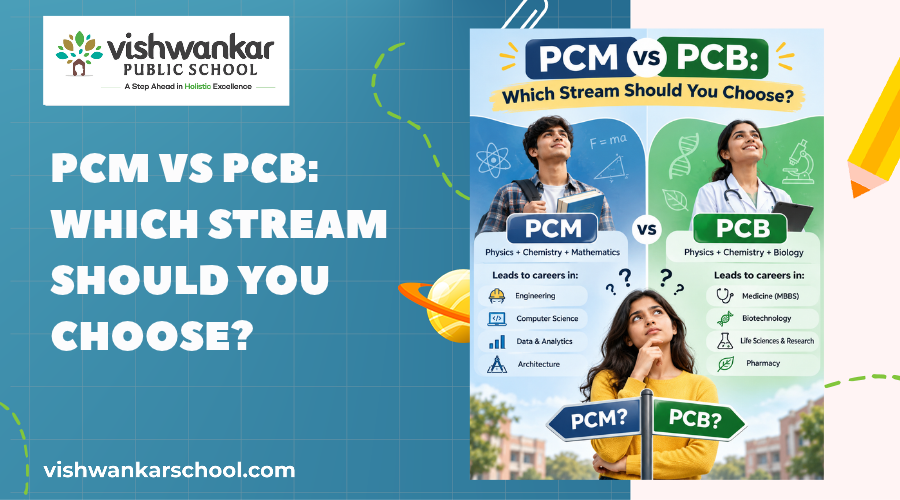
PCM vs PCB is a common question among students choosing their Class 11 subjects. PCM combines Physics, Chemistry and Mathematics, while PCB includes Physics, Chemistry and Biology. Students interested in engineering, technology and mathematical fields may prefer PCM. Those drawn to medicine, healthcare and life sciences may find PCB more suitable.
Quick Overview Table
| Thing | Why it matters |
| PCM | Includes Mathematics for quantitative pathways |
| PCB | Includes Biology for life science pathways |
| Common subjects | Physics and Chemistry feature in both |
| PCMB | Combines Mathematics and Biology |
| Career direction | Depends on course eligibility and interests |
Table of Contents
- What Is PCM and PCB?
- PCM vs PCB – Quick Comparison
- PCM Subjects in Class 11
- PCB Subjects in Class 11
- Difference Between PCM and PCB
- Career Options After PCM
- Career Options After PCB
- Entrance Exams and Higher Studies
- PCM or PCB – Which Is Better?
- What About PCMB?
- How to Make the Right Stream Choice
- Conclusion
- Frequently Asked Questions
What Is PCM and PCB?
When schools offer science combinations in Class 11, students usually come across two familiar options. The PCM and PCB full form explains what each combination contains.
- PCM: Physics, Chemistry and Mathematics.
- PCB: Physics, Chemistry and Biology.
The PCM stream full form is Physics, Chemistry and Mathematics. Similarly, the PCB stream full form is Physics, Chemistry and Biology.
Both combinations share two subjects. The choice between them comes down to whether a student wants to study Mathematics or Biology as the third core subject.
PCM vs PCB – Quick Comparison
The difference becomes easier to understand when the two combinations are placed side by side.
| Factor | PCM | PCB |
| Third subject | Mathematics | Biology |
| Main approach | Calculations and logical reasoning | Observation and biological concepts |
| Common entrance exam | JEE for relevant courses | NEET for applicable medical courses |
| Study interest | Numbers, patterns and equations | Living organisms and their functions |
| Higher studies | Engineering, architecture, physical sciences | Medicine, pharmacy, life sciences |
| Career direction | Technical and quantitative fields | Healthcare and biological fields |
The table gives a broad picture. Individual degree programmes may have additional subject and admission requirements.
PCM Subjects in Class 11
The PCM subjects class 11 students study go beyond the Science topics introduced in Class 10. Each subject requires a different approach to understanding and applying concepts.
- Physics: Students explore motion, laws of force, energy, waves and electricity.
- Chemistry: Topics include atomic structure, chemical bonding, elements and chemical reactions.
- Mathematics: Students work with trigonometry, algebra, coordinate geometry, sequences and other mathematical concepts.
The PCM subject full form is often searched by students who are comparing school subject combinations. English and electives may also be included according to the board and school.
PCB Subjects in Class 11
For students interested in living systems, the PCB subjects class 11 combination introduces a different set of concepts.
- Physics: Covers motion, mechanics, energy and electricity.
- Chemistry: Includes atomic structure, bonding, organic chemistry and chemical reactions.
- Biology: Introduces cell structure, plant and animal kingdoms, biological classification and human physiology.
A PCB subject often requires students to connect diagrams, terminology and biological processes rather than study each concept in isolation.
English and optional subjects depend on the school’s available combinations.
Difference Between PCM and PCB
The difference between PCB and PCM is not limited to the third subject. It also affects the kind of academic work students spend more time doing.
In Mathematics, students usually work through problems until they reach an answer. Biology involves understanding structures, functions and relationships between different living systems.
There is no reliable way to decide which is easier for everyone. A student who enjoys solving equations may struggle with memorising biological terminology, while another may find mathematical applications difficult.
Career Options After PCM
Students taking PCM can consider courses where mathematical understanding and scientific reasoning are useful.
Some possible directions include:
- Engineering: Civil, mechanical, electrical and computer science engineering.
- Technology: Software development, information technology and related fields.
- Architecture: Building design and spatial planning through eligible programmes.
- Data-related fields: Statistics, analytics and selected data science courses.
- Pure sciences: Physics, Mathematics and scientific research.
- Defence and aviation: Eligible technical and aviation-related programmes.
Students should check the admission conditions for each course. A PCM combination does not automatically meet every programme’s requirements.
Career Options After PCB
Biology opens up several study areas beyond becoming a doctor. Students can look at healthcare as well as courses focused on biological research.
Possible options include:
- Medicine and dentistry: MBBS and BDS through the applicable admission process.
- Pharmacy: Pharmaceutical sciences and drug-related studies.
- Nursing: Patient care and clinical support.
- Physiotherapy: Movement, rehabilitation and physical recovery.
- Biotechnology: Biological applications in research and industry.
- Life sciences: Microbiology, zoology, botany and related disciplines.
Some programmes require entrance examinations, while others follow different admission procedures.
Entrance Exams and Higher-Study Pathways
Entrance examinations depend on the degree rather than the stream name alone.
| Examination | Related study pathway |
| JEE Main | Engineering and other eligible programmes |
| JEE Advanced | IIT undergraduate engineering admissions |
| NEET-UG | Applicable undergraduate medical courses |
| NATA | Architecture aptitude assessment |
Students preparing for JEE Main can visit the NTA website for exam dates, application details and updates. Those planning to take NEET-UG can find the latest exam information on its official website. For NATA, students can check the Council of Architecture website for the latest exam details and admission requirements.
Always read the latest information bulletin before applying. Eligibility rules, subject combinations and admission conditions can change.
PCM or PCB – Which Is Better After Class 10?
Students often ask PCM or PCB which is better, expecting one clear winner. But the answer depends on what they want to study for the next two years and where they hope to go afterwards.
Think about your preference before selecting:
- Do you enjoy working with numbers and mathematical problems?
- Are you curious about the human body, plants and living organisms?
- Which subject can you imagine studying in greater detail?
- Have you checked the Class 12 subject requirements for your preferred degree?
- Are you choosing a stream because you like it or because someone suggested it?
A career goal can help narrow the choice, but it should not be the only deciding factor. Students who are still exploring can discuss their options with teachers and career counsellors.
What About PCMB?
Some schools also offer PCMB, which combines Physics, Chemistry, Mathematics and Biology. The PCMB subjects class 11 combination allows students to continue studying both major third-subject options.
This can be useful when a student has genuine interest in both fields or has not settled on a particular direction.
However, four core science subjects need considerable study time. Before selecting PCMB, check whether you can manage the workload alongside school assessments and entrance preparation.
How to Make the Right Stream Choice
A stream decision should involve more than looking at marks or following the choices made by classmates.
Before finalising your subjects, take these steps:
- Look at your interests: Identify which subjects you willingly spend time learning.
- Review your Class 10 performance: Notice where you understand concepts comfortably, not just where you scored higher.
- Explore degree options: Read about course duration, admission requirements and future study opportunities.
- Speak to teachers: Ask them where your academic strengths are.
- Check school facilities: Find out whether the school offers the required subjects, laboratories and academic support.
Parents comparing the best CBSE schools in Coimbatore for 11th and 12th should also check whether the school provides the science combinations their child wants.
Conclusion
The decision between PCM vs PCB should come from an understanding of your interests, academic strengths and future plans. Neither combination guarantees a particular career, and both have several study opportunities.
Take time to compare the subjects, check admission requirements and speak with people who can guide you. Choose a combination that you can see yourself studying with interest throughout Class 11 and Class 12.
Frequently Asked Questions
1. What is the main difference between PCM and PCB?
The only subject that changes between these two streams is Maths and Biology. PCM students study Maths, whereas PCB students have Biology along with Physics and Chemistry. This difference matters later when applying for college, as some courses accept only students who have studied particular subjects in Class 11 and 12.
2. Which is better, PCM or PCB?
PCM and PCB offer different study options, so the choice comes down to what a student wants to learn. If you enjoy Maths and subjects related to technology, PCM may be worth considering. If Biology and healthcare interest you more, PCB could be a better fit. Also, check the subjects required for the course you plan to take after Class 12.
3. Which is tougher, PCM or PCB?
For some students, Maths takes more effort because solving problems needs regular practice. Others find Biology harder, especially when they have to remember scientific terms and understand how different processes work. Physics and Chemistry need attention in both streams. So, the difficulty comes down to the subjects you are comfortable studying.
4. Can I take both Mathematics and Biology?
PCMB is available in some schools. Students who choose it have to study Physics, Chemistry, Mathematics and Biology. It can be a suitable option for those who don’t want to give up either Maths or Biology. Before opting for it, consider whether you can manage both subjects along with your regular classes and exams.
5. Is PCB only for medical careers?
No. PCB students can explore biotechnology, microbiology, pharmacy, nursing, physiotherapy, zoology and several other life science programmes. Medical education is one possible direction, but it is not the only reason to choose Biology in Class 11.
6. Is PCM only for engineering?
No. Students with PCM can explore architecture, computer science, mathematics, physics, statistics, aviation and other technical fields. Different programmes have different admission conditions, so check the required Class 12 subjects before deciding on a particular career.
7. Can students change their career direction later?
A student who changes their career plan after Class 12 may still have other options. However, getting into a different course is not always straightforward. Some colleges ask for subjects the student hasn’t studied or require a separate entrance exam.
8. What should I choose if I am unsure after Class 10?
Start by identifying the subjects you enjoy and the topics you understand comfortably. Read about different degree options and speak with teachers or career counsellors. If both Mathematics and Biology interest you, ask your school about PCMB and its academic demands.
