

What Is a Migration Certificate? Difference Between Migration and TC Certificate
Quick Answer
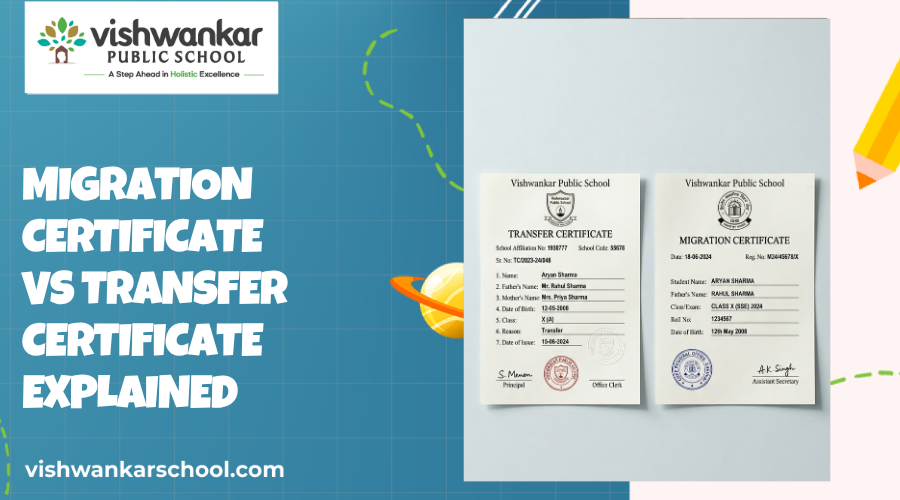
A migration certificate is an official document provided by a board or university that authorises a student to transfer from one educational board to another. It is not equivalent to a Transfer Certificate (TC).
Quick Overview Table
| Topic | Key Gist |
| Migration Certificate | Official document issued by a board to allow joining another board/university |
| Transfer Certificate (TC) | Issued by the school upon leaving; needed for new school admission |
| Key Difference | Migration = board/university level; TC = school-to-school transfer |
| Who issues the Migration Certificate | CBSE, state boards, or universities, upon student request |
| When You Need It | Board change, state relocation, college admission or university transfer |
| How to Apply | Submit application + documents to the board office or the DigiLocker portal |
Table of Contents
- Introduction
- What is a Migration Certificate? – Definition, Purpose, When It Is Required
- What is a Transfer Certificate (TC)? – Definition and Use
- Migration Certificate vs Transfer Certificate – Key Differences Explained
- Why the Migration Certificate Is Important for Students
- When Do You Need a Migration Certificate?
- How to Apply for a Migration Certificate – Step-by-Step Process
- Documents Required for Migration Certificate
- Common Mistakes to Avoid While Applying – Key Takeaways
- Role of DigiLocker in Obtaining a Migration Certificate
- FAQs
- Conclusion
Introduction
Academic transitions are a regular aspect of a student’s journey whether it is moving to a new city, changing schools, or applying to a college from a different board. During such changes, students frequently meet two documents: the migration certificate and the Transfer Certificate (TC).
This blog explains all you need to know about both documents in clear, student-friendly language.
What is a Migration Certificate? – Definition, Purpose, When It Is Required
A migration certificate is an official document issued by an educational board or university that allows a student to transfer from one board or institution to another. It confirms that the student was enrolled with a certain board and has no outstanding academic dues or responsibilities.
- Purpose: Provides official approval to quit one board and join another
- When required: Board change, interstate relocation, college or university entrance
- Who issues it: The board (e.g., CBSE) or the university the student is leaving
- Validity: Single-use; once submitted to a new university, it cannot be used again
What is a Transfer Certificate (TC)? – Definition and Use
A Transfer Certificate is a document issued by a school’s principal when a student officially quits the institution. It is a school-level document, not a board-level one, and acts as verification that the student has finished their enrolment with the school and has no outstanding dues or disciplinary issues.
- Issued by: The principal or head of school
- Used for: enrolling in a new school at any level, from primary to higher secondary
- Content includes: Name, date of birth, class last studied, conduct, and character remarks
- Processing time: Typically issued within a few business days of application
Migration Certificate vs Transfer Certificate – Key Differences Explained
Here’s a simple comparison to help you understand the difference between a migration certificate and a transfer certificate:
| Feature | Migration Certificate | Transfer Certificate (TC) |
| Issued By | Board / University | School Principal |
| Purpose | Board or university change | School-to-school transfer |
| Level | Board / Higher Education | School Level |
| Validity | One-time use | One-time use |
| Required For | College/university admission | New school admission |
| Processing Time | Immediate to a few days | 7–30 days (board-dependent) |
Why a Migration Certificate Is Important for Students
Here’s why this document is important:
- Proof of Board Exit: This is official confirmation that you have formally left your prior board
- College Admission: Most colleges demand it, along with grade sheets and other certificates
- Prevents Dual Enrollment: Ensures that no student is registered in two boards simultaneously
- Scholarship Requirements: Some merit-based scholarships require validation of academic credentials
- Needed for Competitive Exams: Certain entrance exam authorities use this document to prove board affiliation
When Do You Need a Migration Certificate?
There are various academic contexts in which this document is required. Knowing when to apply in advance will help you avoid last-minute stress:
- When transferring from a CBSE to a state board school, or vice versa
- When applying to colleges or institutions governed by a different board
- When migrating to another state and enrolling in a school or college with a different state board
- When applying to a central university or a deemed institution with a state board background
- When transitioning between undergraduate and postgraduate study
Also read: https://vishwankarschool.com/cbse-vs-state-board/
How to Apply for a Migration Certificate – Step-by-Step Process
The application process for a migration certificate varies slightly from board to board, but the overall steps are fairly consistent. Here is a step-by-step guide:
- Visit your board’s official website
- Download the application form
- Fill in your details
- Attach required documents
- Pay the processing fee
- Submit to the board office
- Track your application
- Collect the certificate
Documents Required for Migration Certificate
Before submitting your application, make sure you have acquired all required documents.
- Original or attested copy of your mark sheet (class 10 or 12)
- School leaving certificate or transfer certificate
- The board issued the admit card/hall ticket
- Character certificate from the school principal
- Completed migration certificate application form
- Proof of fee payment (demand draft or online payment receipt)
- ID proof – Aadhaar card or passport (for verification purposes)
Common Mistakes to Avoid While Applying – Key Takeaways
Here are the most typical mistakes that students make and how to avoid them:
- Applying too late
- Missing documents
- Wrong application form
- Submitting unattested copies
- Using the certificate for multiple admissions
- Not tracking application status
The best CBSE school in Coimbatore ensures students receive appropriate supervision throughout their academic journey.
Tips to Speed Up the Migration Certificate Process
Here are some useful tips:
- Apply right away when your board results are announced – do not wait
- If you are a CBSE student, use DigiLocker; it is faster and more convenient
- Make several copies of all papers before submitting
- If applying by mail, use registered or speed post and save the tracking ID
- Follow up with the regional board office or visit the tracking portal once a week
- When visiting the board office, bring originals, as they may be necessary for spot verification
Conclusion
A Transfer Certificate allows you to leave one school and join another, but a Migration Certificate is your formal withdrawal from an educational board. Being well-prepared ensures that your admissions process is seamless, quick, and stress-free.
FAQs
1. What is a CBSE migration certificate?
A CBSE migration certificate is an official document issued by the Central Board of Secondary Education.
2. Is the migration certificate and transfer certificate the same?
No, they are not identical. A TC is issued by a school when a student leaves the institution. An educational board or university issues a migration certificate.
3. How to get a migration certificate from Digilocker?
CBSE students can access DigiLocker using their Aadhaar-linked mobile number, browse to “Issued Documents,” pick CBSE, choose the academic year, and download their migration certificate directly without physically visiting any office.
4. How to get a migration certificate from the CBSE board?
To obtain a CBSE migration certificate, complete the official application form available on the CBSE website, attach your mark sheet, admission card, and character certificate, pay the processing cost, and send it to your regional CBSE office by mail or in person.
5. Who can give a migration certificate?
A migration certificate can only be provided by a certified educational board, such as CBSE, ICSE, or a state board, or by a university. Individual schools cannot produce this paperwork.
6. Does CBSE give a migration certificate?
Yes, CBSE gives migration certificates to students who completed Class 10 or Class 12 at a CBSE-affiliated school. Students can apply online via the CBSE website or access the document directly through their DigiLocker account.
7. What are 5 reasons to migrate?
Students often switch boards owing to a move to another state, a choice for a different curriculum, better college or job opportunities, advice from academic counselors, or because the chosen college is linked with a different board than the one they previously attended.
8. How to get a migration certificate for students?
Students must apply to their relevant board or university with the necessary documents (mark sheet, TC, admit card, and completed application form) and pay the appropriate fee.